
A company announces a new round of funding. Another begins hiring aggressively. A growing business opens its first office in a new city.
To most people, these are ordinary business announcements. To a commercial real estate professional, they can be the beginning of a conversation.
Identifying potential tenants has always required a combination of market knowledge, relationships and good timing. But as information becomes more accessible, the opportunity lies in recognizing what that information might mean before everyone else does.
Here are five signals worth paying attention to.
1. A sudden increase in hiring
When a company begins expanding its workforce, its real estate requirements may eventually follow.
A technology company hiring 50 new employees might need additional office space. A logistics business adding warehouse staff could be preparing to increase its distribution capacity.
Of course, hiring doesn't automatically translate into a lease. Remote work, operational changes and existing space utilization all influence real estate decisions.
But a sustained hiring trend can be a useful reason to investigate further.
What to watch: Job postings, LinkedIn hiring activity, company announcements and expansion plans.
2. New funding or an acquisition
Capital creates possibilities.
When a company secures financing, acquires another business or announces a major investment, its operational requirements may change.
That could mean consolidating offices, expanding into new markets, relocating facilities or investing in additional space.
Acquisitions are particularly interesting because they can create both expansion and consolidation opportunities.
What to watch: Funding announcements, mergers and acquisitions, investor presentations and corporate restructuring news.
3. An approaching lease expiration
Sometimes the clearest signal is also the most straightforward.
A lease expiration creates a natural opportunity for a business to reassess its space requirements.
Does the company need more room? Less room? A different location? Better amenities? Or does renewing make the most financial sense?
For brokers, understanding when these decisions are approaching can help create more relevant conversations.
However, timing matters. Larger organizations may begin evaluating their options well before the lease expires.
What to watch: Known lease expiration dates, renewal activity and changes in occupancy requirements.
4. A shift in how the company operates
Real estate decisions often reflect broader changes in business strategy.
A retailer investing in e-commerce may need different distribution capabilities. A professional services firm introducing new workplace policies may reconsider its office footprint.
Similarly, businesses moving toward hybrid work may prioritize different layouts, locations and amenities.
The key is understanding how operational decisions translate into physical space requirements.
What to watch: Return-to-office announcements, operational restructuring, new business models and changes in distribution strategies.
5. Expansion into new markets
When a company announces plans to enter a new market or city, it may eventually need office, industrial or retail space.
The opportunity isn't necessarily limited to the company itself.
New operations can create demand from suppliers, logistics partners, service providers and other businesses supporting that expansion.
One corporate announcement can sometimes point toward several potential real estate opportunities.
What to watch: New market announcements, business registrations, development plans and regional investment news.
From information to opportunity
None of these signals guarantees a transaction.
A hiring announcement doesn't automatically mean a company needs a new office, and a funding round doesn't always lead to expansion.
But together, these signals can help commercial real estate professionals ask better questions, identify potential opportunities and approach prospects with more relevant information.
The challenge is that useful intelligence rarely lives in one place. It's spread across company websites, news articles, property databases, professional networks and conversations.
And with new developments emerging every day, staying informed can be a time-consuming process.
Introducing Corporate Signals
CRE Tour de Force is helping commercial real estate professionals stay ahead of these developments with Corporate Signals, an AI-powered feature designed to surface corporate activity that could signal future real estate opportunities.
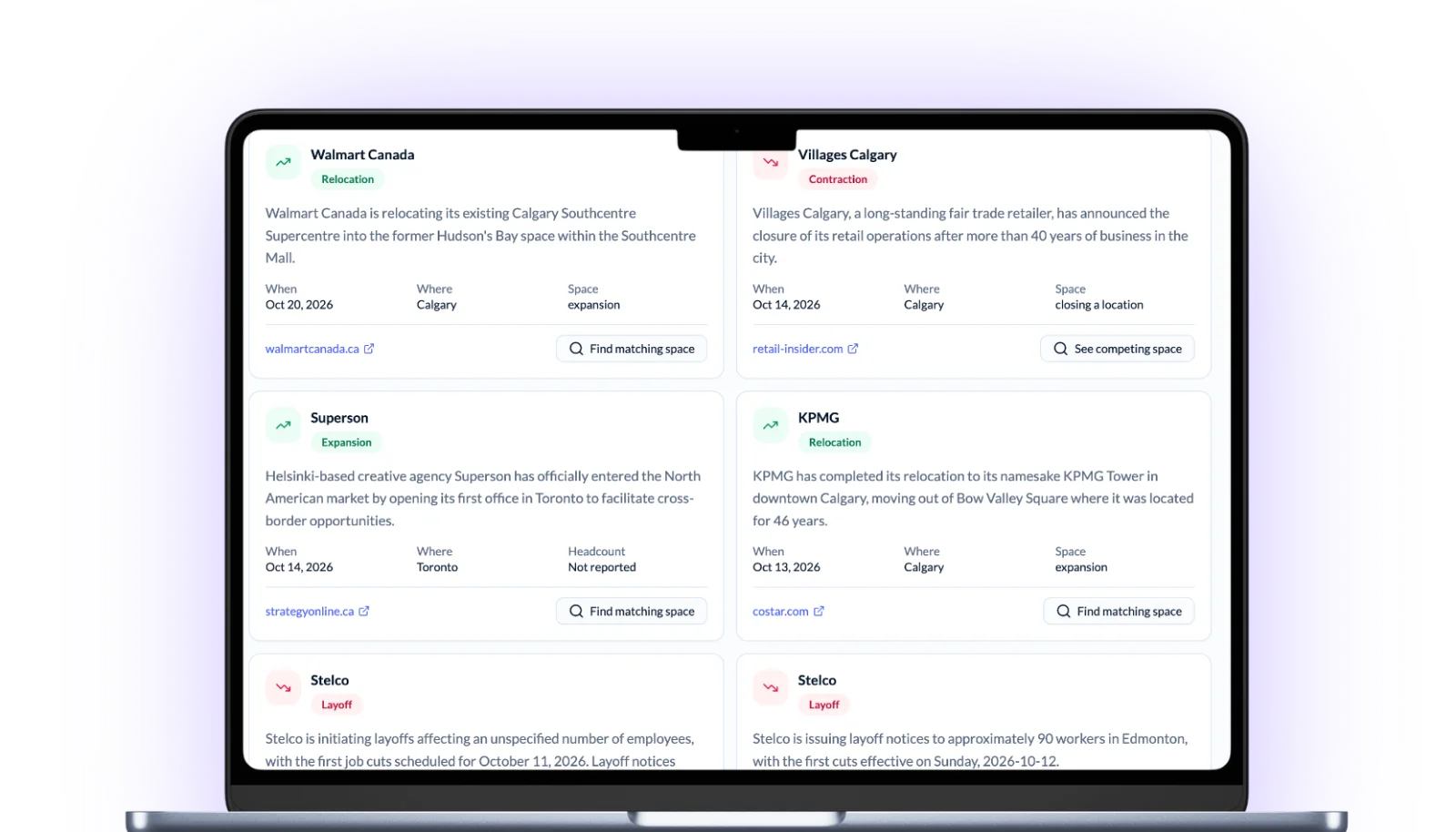
Every night, Corporate Signals searches for news about companies expanding, contracting, raising capital or making acquisitions, bringing relevant developments together in one place.
A Calgary company securing $10 million in funding. A national retailer announcing new locations. An acquisition that could lead to office consolidation.
These announcements don't guarantee a real estate transaction, but they can provide an important starting point for identifying potential business opportunities.
Instead of spending hours searching across multiple sources, CRE professionals can use Corporate Signals to stay informed, investigate emerging opportunities and start more relevant conversations.
Know more. Move faster.
Commercial real estate has always been a relationship-driven business. Better access to information doesn't replace those relationships. It helps professionals make better use of them.
CRE Tour de Force is being built around that idea: bringing useful commercial real estate intelligence together so professionals can spend less time searching and more time identifying opportunities.
Be among the first to explore a smarter way to navigate commercial real estate.